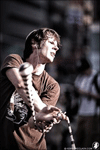
A gig over the weekend afforded me the opportunity to pull out a pair of flag poi I hadn't used in forever and realized a lot of my tech worked even with the tails. The first minute and a half of this is choreo I'd developed for a different performance up in Philly this past weekend that didn't come together. After that it's all improv and a whole lot of fun :)
Showing posts with label dance. Show all posts
Showing posts with label dance. Show all posts
Thursday, October 1, 2009

Friday, July 17, 2009
Experiments in body mechanics
I spent a good long time in my poi practice session today playing with the way my body shifts its weight as I spin. Teaching in a dance studio, I'll freely confess I have a bit of a chip on my shoulder due to the fact that poi sits so uncomfortably in the middle of dance, juggling, martial arts, and street performance that alas it seems to be none of these as well. Part of the reason for this is that the movements of poi (especially tech poi) are so incredibly focused on the upper body that it's ridiculously easy to perform an entire routine's worth of material without ever moving your feet.
Given the wonderful expressiveness of the human body, it begs the question of if poi is an instrument to frame the body's movements or the body is merely the frame around the poi's movements. While it's easy to chime in wanting to avoid easy categorization and claim the answer is both, I'd submit for the record that in my day I can count the number of poi spinners who've used their poi in the former way rather than the latter.
It's not hard to see why this route is preferred. After all, most of us who come to poi spend our countless hours dissecting antispin movements, compound circles, and the all-important cateye and zero-point stalls that will make us look like tech badasses. Few of these maneuvers require us to do much more than pivot 180 degrees to turn with a figure, however. It's the very rare poi spinner who invests much time in how to move their bodies in a similarly striking fashion and thus, those who do frequently are derided by tech spinners for relying on moves shunned as being to simple.
Lately I've been trying to do both--today's experiment was in center of gravity. I usually warm up by guiding my arms through all four combinations of poi timing and direction and then by doing a number of turns with these combinations. It's very easy to do these with weight squared to the ground, only shifting when turns are necessary. But what about if we imagined our hands guiding not just our poi, but also our body weight, such that moving our hands around in same-time, same-direction results in having our hands/poi hover over each foot and then our mid-line sequentially. The effect is actually quite striking. Similarly, we shift between feet with split-time opposites and we have an excellent opportunity to bounce our weight up and down with opposites same-time. Because split-time same direction requires a balance both vertically and horizontally at all times, it essentially anchors the body in a single position.
Even more interesting is what starts happening when you deliberately work against the center of balance. This requires a mild contortion of the body that possesses many of the asymmetrical properties I've mentioned before that theoretically performance is supposed to embrace. How do other folks out there work dance into their spinning?
Tuesday, June 9, 2009
Tech Video Blog #37: Yuta stalls with floats, hybrids, cateyes, and more footwork
More fun with Yuta stalls! Specifically, it turns out that they work just as well with floats as they do with top and bottom stalls, opening the door to doing them in tandem with isolations, extensions, hybrids and cateyes. Also, some more footwork and danciness inspired by nightanddaydance's excellent response to my last blog. Had to trim a couple tricks out to keep it under 10 minutes, but they should be making an appearance in a later blog.
Monday, June 8, 2009
Footwork in poi
Nightanddaydance posted a great response to my last vid, specifically outlining some more foot and body work for use with poi dancing. Some of the asymmetrical options remind me of a performance class I took in college wherein they emphasized very heavily to us the use of asymmetrical movement and poses to add interest to a performance.
Some examples: in Japanese Noh theater the actors move in a fashion where there appears to be something dragging on their waists, making their movements deliberately slow yet fascinating to watch. Balinese dance is another great example, alternating asymmetric combinations of hand and foot raised. Even the martial art capoeira is centered around essentially being in control of being off balance.
This has given me a lot of ideas I can't wait to play with--check out the video for some cool explorations of how the body can be used for poi performance. We always focus so much on the tricks that it's cool to see some emphasis like this on the rest of the body :)
http://www.youtube.com/watch?v=GQc3Tn6sJto
Subscribe to:
Posts (Atom)