Showing posts with label flowers. Show all posts

Tuesday, June 2, 2009

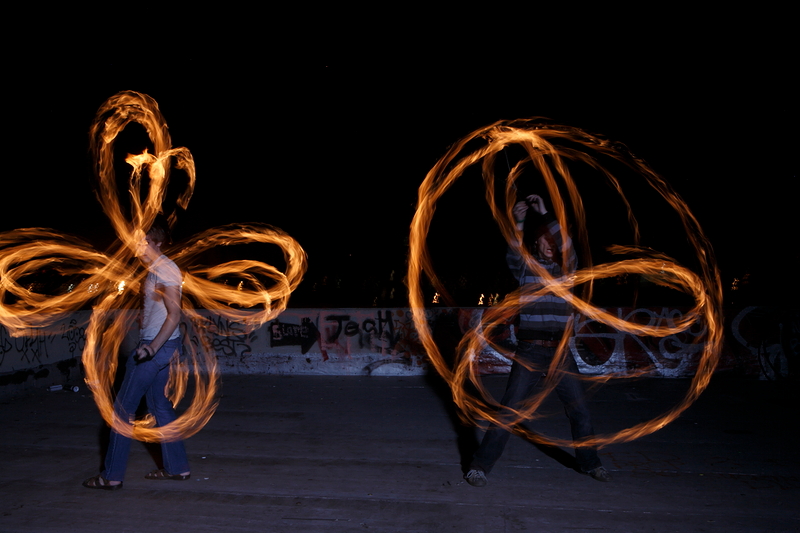
Abject shots from Sean and Tash's roof


Wow...seriously love this shot, Abject--thanks so much for taking these and for the great conversation on Saturday night! :)

http://public.fotki.com/abjectphoto/sean-and-tash-rooft/

Fun with stalls and hybrids

Interesting move combo finds me while I finish up a one-pager on Twitter strategy for work: from same-time opposites do simultaneous top-stalls that stop with the hands right next to each other. Continue the movement of one while isolating the other the opposite direction it just came from, in other words switch to the "split-time" iso vs. extension hybrid with hands together. Playing around after I finish the one-pager shows it's possible, though without a mirror I reckon it's quite sloppy.

Playing with this reminds me of a combo Baz demoed at Firedrums: split-time opposites flower spun in antispin stalls out to a top and bottom stall to one side with the hands separated by a poi length. One continues it's original direction all the other reverses, thus leading to the "same-time" hybrid where the hands move split-time. I try it now without the antispin flower. The hand on bottom does a vertical float and comes back down the same direction as the other hand, thus leading to the same hybrid--cool! :)

While I'm playing with these another 3D pattern starts to form in my head. for this I do a top and bottom stall from split-time opposites, Yuta-style and stall it in corkscrew plane around me to emerge on the other side and rather than going straight back into split-time opposites, I reverse my stalls to make the top hand top stall and bottom hand bottom stall, then horizontal stall back to the other side and allow the poi to complete their paths up and down on the opposite side, thus switching into same-time opposites.

That makes absolutely no sense written out :-P

It's beginning to dawn on me that I should warm up with horizontal as well as vertical plane-bending globes at the beginnings of my practice sessions if I continue to play this much in corkscrew plane.

Sunday, May 31, 2009

In search of the Carolingian Cross

In my last blog posting, I noted an interesting shape based upon the triquetra I'd found in a wikipedia article and was pretty sure could be accomplished with poi--I've spent most of the past evening and day thinking through how and coming up with different approaches to it.

About mid-day today, I thought I'd had it: imagine a square, bisected through both corners. You start at the middle and do a single triquetra, but when you reach the point of origin, you perform another triquetra 90 degrees off of the first one and so on and so forth all the way around the square. I discovered I could do the pattern in under 3 seconds which, according to Abject, is what I should be shooting for to create a recognizable pattern. Below is a diagram I did in Illustrator to visualize the concept.


There's just one problem: this doesn't actually come out looking like the Carolingian Cross in the wikipedia entry. Conceptually they bear similarities, but there is no distinction between the triquetra nodes at each corner. Back to the drawing board.

Using the same method, I tried separating out the center nodes till it began to have the same appearance as the wikipedia figure:


As you can see, the hand path is no longer a simple square--in fact, it appears to be an antispin flower in its own right. Months ago I'd toyed with the idea of compound flowers in this way and this appears to be an excellent test of the idea. Back to practice--let's see if this one is doable.

Further adventures with Triquetras

For most of the past year, I've called this trick a trifoil or antispin flower hybrid, yet somehow overnight the terminology switched to triquetra and I didn't know why until Nick Woolsey posted his latest online tutorial.


The source of the name is interesting to me--especially given that I grew up in a Lutheran church (well, not literally) and triquetra patterns could be found all around. Catholics tend to like their iconography, such as the crucifix and many pictures/paintings of saints and holy people while Protestants tend to wind up with more abstract patterns in their churches. After viewing Nick's vid, I went and checked up on what wikipedia had to say about triquetras and found this helpful article:

http://en.wikipedia.org/wiki/Triquetra

Among the interesting tidbits in it is a fascinating figure that's got my creative juices flowing that includes a triquetra knot in four corners of what looks to me like a four-petal antispin flower. If indeed I'm right in this assessment, I reckon it should be possible to do this figure with poi. As each corner looks like it represents 3/4 of a full circle, my theory is that by stopping at each corner and waiting till the poi is in that 3/4 position before moving on to the next corner, a body can render this knot. Essentially this means that you'd be stopping your hand to let the poi catch up at each corner and then moving it swiftly past the nearest compass point. I'll do a vid if this approach works.
Thursday, May 28, 2009

Noel-ski's timing and direction vids


Noel just finished his series on the different combinations of timing and direction for tools that can be used by each hand independently. I've played with all the poi stuff already, but seeing it render against double-staves was really helpful in terms of translating movement between the two tools and seeing how differently similar ideas come out between them. Doubles give me a lot of trouble because movement on both sides counts as a beat, rather than thinking of them is a poi that continues through the other side of your hand.

The breakdown in isolation hoops is fantastic, too. I am not nearly grokking this tool at all...would have been nice to seen these combos done in fans, too, but I think the tech on fans is still enough in its infancy people haven't played with them in this way just yet.

It'll be fun to take all these movements and work through them in both wheel and wallplane in the same fashion as Insignia and I have spent the past few months breaking apart the components of triquetras and building compound figures out of them, not to mention direction shifts.

One of the things I love about flowers (and that I played with in my first couple poi tutorials) is the fact that each flower pattern has what I'd consider to be transit points between different flower shapes. For example: same time, same direction breaks out into same time, opposites at the apex and bottom of the circle and split-time, opposites at either side--all you have to do is switch the direction of one of your hands. This is partially the idea behind the first trick I showed off in my tech poi vid yesterday, but the examples here are definitely more detailed.

Two thumbs up--keep the vids coming, Noel :)